Spiders, house centipedes, silverfish and camel crickets in CT homes
Most spiders and basement bugs in Connecticut homes can’t hurt you. CAES calls the northern black widow the region’s most medically significant spider, and it is timid and rarely seen. The brown recluse is not native to New England. House centipedes, silverfish and camel crickets all point to the same fix: a drier, better-sealed basement.
This guide draws on fact sheets from the Connecticut Agricultural Experiment Station (CAES), the Connecticut Poison Control Center at UConn Health and university extension services. It starts with the steps that need no pesticide.
Are there poisonous spiders in Connecticut?
Very few, and the one that matters is uncommon. The CAES fact sheet Spiders Found in the House is by Gale Ridge and Katherine Dugas. It counts “approximately 550 species of spiders in Connecticut and most go unnoticed because they are reclusive.” It also says “very few spiders are truly dangerous.”
The one spider CAES singles out is the northern black widow. Its northern black widow fact sheet calls it “the most medically significant spider in the northeast.” The same sheet says the related false widows have bites that are medically significant but less severe.
CAES also cautions against blaming spiders for every sore. Many people and doctors default to “spider bite” for an unexplained wound. The spiders sheet points to “a number of other causes including mosquito bites.” Unless the spider is caught in the act, it says, “a spider bite diagnosis must remain inconclusive.” If you are bitten, catch the spider if you can, even in pieces, so an expert can identify it.
Are there brown recluse spiders in Connecticut?
Not as a native spider. The Connecticut Poison Control Center’s page About Spiders is published by UConn Health. It says plainly: “The brown recluse is not native to any of the New England States.”
Now and then one does arrive. The same page says a brown recluse or black widow will sometimes “make its way to this part of the country.” They come as “passengers” in boxes, crates or cars “that have originated from warmer climates.” The page describes the brown recluse as about two-fifths of an inch long. It has “a dark violin shape” behind its eyes, which gives it the nickname “fiddle back.”
Most “brown recluse bites” reported in this part of the country are something else. In the Poison Control Center’s words, they “are usually caused by other spiders or bugs, or are other medical, non-bite, problems.” That matters for treatment. A bite or wound that is not healing and is getting worse should be seen by a doctor, whatever caused it. The Poison Control Center’s number on the same page is 1-800-222-1222.
Are there black widows in Connecticut?
Yes, but sightings are uncommon. The Poison Control Center says black widows “may be found in Connecticut” and the rest of southern New England. It adds that “true black widow spider sightings or bites are uncommon in New England.”
What a black widow looks like
The CAES northern black widow sheet describes the adult female. Her body is about half an inch long (1½ inches with the legs) and glossy black. A bright red hourglass on the underside of her abdomen is “‘broken’ in the center.” Males and young spiders are smaller, about a quarter inch, with brown legs and whitish bands on the sides. An older CAES sheet by Rose Hiskes is Northern Black Widow, Southern Black Widow Spider. It adds: “The male and juvenile widows do not bite humans.”
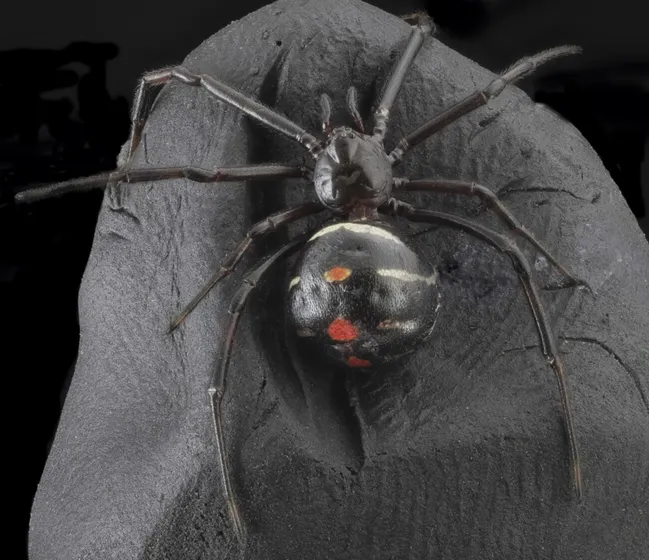
Where they live
Black widows like dark, closed-in places with plenty of anchor points for their webs. CAES lists hollow stumps and rock piles. It also names “colonial stone walls, culverts and wood piles,” and “underused sheds, greenhouses, garages, or attic spaces.” Indoors, the Hiskes sheet says their webs turn up in “crawl spaces, basements, or garages and sheds that are not used or cleaned frequently.”
The Hiskes sheet also records that CAES received “several reports of northern and southern black widow sightings in Connecticut during June, 2013.” Before then, most widows brought to the station “were mostly from bags of South American grapes purchased in local grocery stores.”
What a bite does, and what to do
Bites are rare. CAES says black widows “are very timid.” Bites “usually involve an instinctive panic response when a spider is crushed directly against bare skin,” as when one is trapped inside a glove or boot. Symptoms can include pain at the bite, abdominal cramping, sweating, nausea, tremors and breathing difficulties.
For first aid, CAES says to apply a cold compress and “immediately seek medical attention.” Collect the spider for identification if you can do so without another bite. Fatal bites “are very rare (less than 1% of all cases), especially if there has been medical treatment.” Symptoms “generally subside within 48 hours.” The Poison Control Center adds that if muscle cramps develop or pain is severe, you should go to the nearest hospital.
To avoid bites, CAES suggests wearing gloves with stone or firewood, shaking out stored gloves and boots, and looking before reaching into boxes.
Which spiders are you finding indoors?
Most spiders in Connecticut houses are one of a handful of common species, described in the CAES spiders sheet. None of them is considered medically significant.
| Spider | Size and look | Where you see it | Bite risk (CAES) |
|---|---|---|---|
| Cellar spider (“daddy long-legs”) | Small cream to grayish body, very long thin legs | Dark corners of basements, cellars, bathrooms | Mouthparts “too small to puncture human skin” |
| Wolf spider | Body “usually up to one inch long,” hairy, mottled gray and black | Basements near grass or woods; comes in as fall temperatures drop | “rarely bite people”; venom “not considered medically significant” |
| Yellow sac spider | Greenish-yellow, ¼ to ¾ inch | Silk retreats where walls meet ceilings | “more likely to bite” than other house spiders; locally painful, usually resolves in a few days |
| Giant fishing spider | Body 1 to 1½ inches, 3 to 4 inches across the legs | Boathouses and buildings near water | “not known to bite people” |
| Woodlouse hunter | ½ to ¾ inch, gray abdomen, reddish front and legs | Damp spots, wandering indoors | Bites very rare; not medically significant |
| Jumping spider | Usually under ½ inch, large forward-facing eyes | Wandering indoors; hunts by day | “not known to bite people” |
Wolf spiders in the fall
Wolf spiders are the big, fast spiders that startle people in the basement in autumn. CAES says they live on grasslands, forest floors and sandy ground. In its words: “During the fall as temperatures drop, wolf spiders find their way into buildings where it is warmer.” They hunt at night, running down their prey. Cornered, one may raise its front legs as a bluff, but CAES says they prefer to run away. The fall sealing work in the stink bugs and fall invaders guide helps keep them out too.
Cellar spiders are worth keeping
CAES calls cellar spiders “a natural biocontrol alternative to pesticides.” To clear a web, tap it with the switched-off vacuum nozzle so the spider leaves, then vacuum it.
Why do I have house centipedes?
Because your house suits them. It is damp somewhere, and it has insects for them to eat. The CAES house centipede fact sheet explains: “In temperate zones such as Connecticut, house centipedes primarily live and develop year-round indoors.” They “prefer cool, humid, dark environments,” especially “basements, cellars, and first-floor bathrooms.”
They are easy to recognize: a 1- to 2-inch body with three dark stripes and 15 pairs of long striped legs. They grow slowly, taking “upwards of 3 years” to mature. They can live “as long as 7 years.” They come out at night, and CAES says “Most that live in houses are never seen.”
Are house centipedes dangerous?
No. CAES says “House centipedes do not cause harm to structures or to stored products, fabrics, pets, or humans.” A sting to a person “is very rare” and comes from rough handling. They eat “cockroach nymphs, bed bugs, flies, ants, silverfish, spiders, and all other household pests.” In CAES’s view, “if house centipedes are present and actively hunting, there is little need to use pesticides inside buildings.”
How to see fewer of them
CAES says “Using pesticides to eradicate house centipedes is not recommended.” Instead:
- Lower the humidity “by running fans or dehumidifiers.”
- Fix water problems that keep the basement damp.
- Caulk sump pump seals and fill cracks in the foundation.
Those steps also keep out the insects centipedes hunt, so fewer centipedes have a reason to stay.
How do I get rid of silverfish?
Dry out the rooms they live in and take away their food. The CAES silverfish and firebrats fact sheet calls them “occasional household pests, usually encountered in damp attics or basements.”
Silverfish are flat, wingless and silvery, with a “½ to ¾ inch-long carrot-shaped body,” two long antennae and three tail filaments. Their close relative the firebrat is dull gray with dark markings. It prefers warm, humid spots near furnaces, fireplaces and heating ducts. Both hide in cracks by day and feed at night, mainly on starch: “glue, paste, paper, linens, and many stored products.” Over time that leaves papers and fabrics thinned, “with ragged-edged holes.”
CAES’s prevention list:
- Lower the humidity in basements, crawlspaces and attics.
- Fix plumbing leaks and damp spots in bathrooms, laundry rooms and kitchens.
- Store papers and fabrics in dry, airtight containers.
- Clear out storage regularly: “discard unused cardboard boxes and unwanted newspapers and magazines.”
Patience helps. CAES says infestations “take a long time to establish.” Growth from egg to adult takes “between 3 months to two years,” so “regular sanitation is the best way to keep ahead of and prevent large populations.” For an existing population, the sheet says a desiccant dust may be used in crevices after thorough vacuuming. No pesticide should go in or around food storage or preparation areas. Any product’s label must be read and followed. A certified applicator can advise on whether that step is needed at all.
What are camel crickets?
Camel crickets, also called cave crickets, are wingless, humpbacked crickets with very long legs. They live in damp basements, crawlspaces and garages. This guide found no CAES or UConn fact sheet on them, so this section relies on university extension services in other states.
NC State Extension’s camel cricket page explains the name. It comes from their “slightly humpbacked appearance,” and “they do not have wings as adults.” Outdoors they live “under stones and logs, or in stacks of firewood.”
Iowa State University’s Yard and Garden entry puts them at “up to one inch long.” It calls them “of little economic importance except as a nuisance in buildings and homes, especially basements.” NC State notes that one Asian species, the greenhouse stone cricket, “frequently becomes a nuisance indoors.” Camel crickets left unchecked can also damage stored garments and linens, it says.
Why camel crickets are in your basement
They come for the damp. The Missouri Department of Conservation’s field guide covers large numbers in a basement. In that case, “it could mean you have a moisture problem that should be addressed.” Iowa State adds that they “generally do not reproduce indoors, except in situations that provide continuous dark, moist conditions.”
How to get rid of camel crickets
- Dry the space. NC State says to “Reduce moisture indoors, as well as in other critical areas such as basements or crawlspaces.”
- Seal entry points around window frames, doors, the foundation “and clothes dryer vents” (NC State).
- Clear hiding spots outside: Iowa State says piles of bricks, stones, boards and leaves “should be removed.”
- Trap and sweep. NC State suggests sticky boards like those used for cockroaches and mice, placed in corners and behind appliances. Iowa State says single crickets can simply be swept up. Treating indoor floors where they hide “is a last resort of limited benefit.”
Why all four end up in the basement, and how to keep them out
Spiders, house centipedes, silverfish and camel crickets have one thing in common. They need moisture, and Connecticut basements often supply it. The CAES spiders sheet puts it simply: spiders “do not like dry environments.” Running a dehumidifier or fixing leaks “will discourage spiders and their prey.” Once their prey goes, the predators follow.
A practical plan built on the CAES and extension advice:
- Measure the humidity. The U.S. EPA’s guide to mold and moisture recommends keeping indoor humidity “below 60 percent (ideally between 30 and 50 percent).” It says to use air conditioners or dehumidifiers when needed. A basement that reads well above that is an invitation to all four.
- Run a dehumidifier in the basement through the damp months, and vent the clothes dryer outdoors.
- Fix the water. Repair plumbing leaks, keep gutters and downspouts carrying water away from the foundation, and caulk around the sump pump.
- Seal the shell. CAES recommends “caulking exterior cracks and crevices, sealing windows, and screening vents.” It says this also keeps out rats and mice. The mouse and rodent control guide covers the larger gaps.
- Declutter storage. Move papers and fabrics into airtight bins, recycle old cardboard, and lift stored items off the floor.
- Clean up the yard edge. Move firewood, stone and board piles away from the foundation.
Carpenter ants also follow damp, water-damaged wood; see carpenter ants vs termites.
When does a certified applicator make sense?
For most spiders and basement bugs, the Connecticut sources say a pesticide isn’t the first answer. CAES says “Active control of spiders does not require the use of pesticides.” Black widow control in buildings “does not require pesticides,” it says, and pesticides are “not recommended” for house centipedes. The Hiskes black widow sheet adds that sprays “can reduce the number of spiders” but come with “no guarantee of complete control.”
Situations where homeowners do call in a pest control company include:
- Black widows found repeatedly in a garage, shed or crawlspace that people use often.
- A heavy silverfish or camel cricket population that persists after the basement has been dried and sealed.
- Bugs that may be something else. If you are unsure what you have, get it identified first. The CAES Insect Information Office takes questions and samples from Connecticut residents by phone, email, mail or in person. Its New Haven number is (203) 974-8600. Cockroaches have their own guide: cockroach control.
If you hire someone, Connecticut law sets the rules. Anyone applying pesticides for hire must hold a DEEP certificate under CGS 22a-54. The business must be registered with DEEP and print its registration number on written contracts, vehicles and newspaper, billboard and directory ads. DEEP’s category descriptions put “general household pests such as fleas, cockroaches, bedbugs, ants, etc.” under category 7A, General Pest Control. Outside, category 3A, Ornamental and Turf, covers centipedes, millipedes, pill bugs, sow bugs, earwigs “and spiders.” It may treat “on the outside foundation of the structure, but not within the structure.” Ask the company what it plans to do about moisture and entry points, not only what it will apply. The FAQ explains how to check a company’s DEEP registration.
Sources
- CAES, Spiders Found in the House (Gale E. Ridge and Katherine Dugas): https://portal.ct.gov/-/media/caes/documents/publications/fact_sheets/entomology/spiders_in_the_house.pdf
- CAES, Northern Black Widow Spider (Katherine Dugas): https://portal.ct.gov/-/media/caes/documents/publications/fact_sheets/entomology/northern_black_widow_latrodectus.pdf
- CAES, Northern Black Widow, Southern Black Widow Spider (Rose Hiskes): https://portal.ct.gov/-/media/caes/documents/publications/fact_sheets/entomology/black-widow-spider_northern-and-southern_fact-sheet.pdf
- Connecticut Poison Control Center, UConn Health, About Spiders: https://health.uconn.edu/poison-control/about-poisons/outdoor-items/arachnophobia/
- CAES, House Centipede (Katherine Dugas): https://portal.ct.gov/-/media/caes/documents/publications/fact_sheets/entomology/house_centipede_scutigera.pdf
- CAES, Silverfish and Firebrats (Katherine Dugas): https://portal.ct.gov/-/media/caes/documents/publications/fact_sheets/entomology/silverfish_firebrats_zygentoma.pdf
- NC State Extension, Camel Crickets (revised June 14, 2023): https://content.ces.ncsu.edu/camel-crickets
- Iowa State University Extension and Outreach, Yard and Garden: Camel Cricket: https://yardandgarden.extension.iastate.edu/encyclopedia/camel-cricket
- Missouri Department of Conservation, Camel Crickets (Cave Crickets): https://mdc.mo.gov/discover-nature/field-guide/camel-crickets-cave-crickets
- U.S. EPA, A Brief Guide to Mold, Moisture and Your Home: https://www.epa.gov/mold/brief-guide-mold-moisture-and-your-home
- CAES, How to submit insects for identification: https://portal.ct.gov/caes/knowledge-base/articles/submit-insects-for-identification
- Connecticut General Statutes, chapter 441 (section 22a-54): https://www.cga.ct.gov/current/pub/chap_441.htm
- CT DEEP, Commercial Pesticide Applicator Certification Category Descriptions: https://portal.ct.gov/-/media/deep/pesticides/certification/supervisor/catinfopdf.pdf
Frequently asked questions
Are there brown recluse spiders in Connecticut?
Not as a native spider. The Connecticut Poison Control Center at UConn Health says the brown recluse is not native to any New England state. Now and then one arrives as a passenger in boxes, crates or cars from warmer places. Suspected recluse bites here usually turn out to be other bugs or non-bite medical problems.
Are there black widow spiders in Connecticut?
Yes, but they are rarely seen. CAES says the northern black widow lives here, mainly in woodland, stone walls, woodpiles and little-used sheds or garages. Females are glossy black with a broken red hourglass underneath. They are timid and rarely bite. Bites usually happen when a spider is crushed against bare skin, as inside a glove or boot.
Are house centipedes dangerous?
Not usually. The CAES house centipede fact sheet says they do not harm structures, stored food, fabrics, pets or people. A sting is very rare and comes from rough handling. They hunt silverfish, cockroach nymphs, spiders and other household pests. Seeing many of them points to damp conditions and to prey in the house.
What attracts silverfish to a house?
Damp and starch. CAES says silverfish prefer cool, humid places such as basements. They feed mainly on starchy materials: glue, paste, paper, linens and stored products. Its main advice is to lower humidity, fix leaks, store papers and fabrics in dry airtight containers and clear out old cardboard and newspapers.
Do camel crickets mean I have a moisture problem?
Often. Camel crickets live in cool, damp places such as crawlspaces and basements. The Missouri Department of Conservation says large numbers in a basement could mean a moisture problem that should be addressed. Iowa State University adds that they generally do not breed indoors unless conditions stay dark and moist all the time.
Should I call an exterminator for spiders?
Usually it is not needed. CAES says controlling spiders and black widows in buildings does not require pesticides. Catch and release strays, vacuum webs, dry out damp rooms and seal gaps. If you hire a company anyway, Connecticut requires a certified applicator from a DEEP-registered business.