Spotted lanternfly in CT: quarantine, season and what to do
Spotted lanternfly is a sap-feeding plant pest, first found in Fairfield County in 2020 and seen in every Connecticut county by 2025. It does not bite, sting or carry disease. The whole state is under a CAES quarantine, and Connecticut has no public control program, so managing it on your property is up to you.
Pest calendar
| Pest | Peak months | January | February | March | April | May | June | July | August | September | October (this month) | November | December |
|---|---|---|---|---|---|---|---|---|---|---|---|---|---|
| Spotted lanternfly, 1 | Jul–Nov | none reported | none reported | none reported | active | active | active | peak | peak | peak | peak | peak | none reported |
- Peak: the busiest months
- Active
- None reported
- October (this month)
Sources
What is the spotted lanternfly?
It is an invasive planthopper from Asia, first seen in Pennsylvania in 2014. The CAES spotted lanternfly page says it “was first found in Fairfield County in 2020.” The page adds: “As of 2025, SLF has been seen in all counties.” The quarantine order itself lists established populations in Fairfield, Litchfield, New Haven, New London, Hartford and Tolland counties.
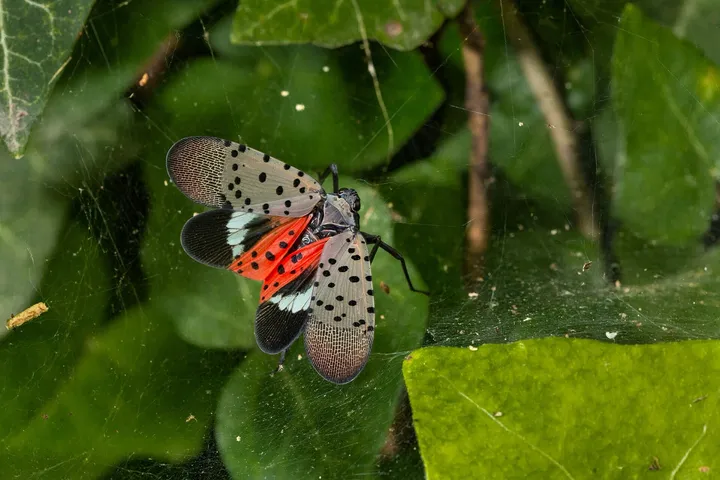
Adults “can feed on more than 70 types of plants,” CAES says. The preferred host is tree-of-heaven, an invasive tree common along roads, fields and parking lots. The “important plants it may damage are grapes, hops, and ornamental trees.”
For people, it is a nuisance rather than a danger. The CAES fact sheet Spotted Lanternfly Management for Residents says it “does not bite or sting, nor does it carry diseases.” What homeowners notice is the honeydew: a sugary waste that coats decks, cars and plants under infested trees and grows black sooty mold.
How many Connecticut towns have spotted lanternflies?
CAES does not publish a count of towns, and the quarantine covers the whole state regardless. What it does publish is a map of valid reported sightings by town, with data “accurate as of October 20, 2025.” The map shades each town with at least one valid report, meaning a report with a location and a photograph. It also warns that “Presence of SLF does not indicate an active infestation.” So a shaded town is not the same as a town with an established population. To see whether your own town is shaded, open the map from the CAES spotted lanternfly page.
When are eggs, nymphs and adults out?
There is one generation a year. The CAES page gives the seasons:
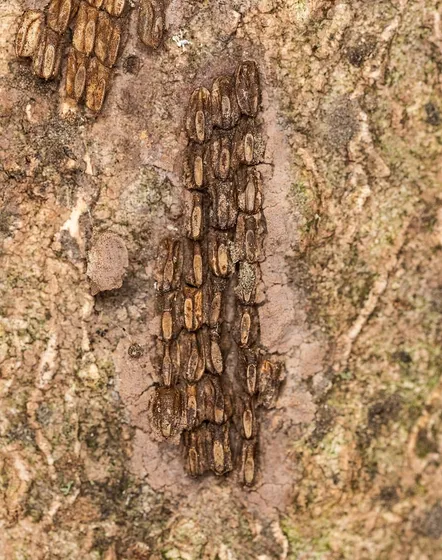
- Egg masses: September to May. Laid on hard surfaces such as trees, decks, houses, outdoor equipment and rocks, each mass holding 30 to 50 eggs, per the residents’ fact sheet.
- Nymphs: April to October. The early stages are black with white spots; the last stage is red with white dots and black stripes.
- Adults: July to November. About an inch long, with gray, black-spotted forewings. “In the fall, large groups of adults can be found on tree-of-heaven and other host trees,” CAES says.
So late summer and fall are when adults are most visible, and fall through spring is the time to look for egg masses.
What does the quarantine require?
The quarantine covers the whole state. The order says “The State of Connecticut is quarantined and designated as the regulated area.” It regulates living lanternflies, plants and plant parts including firewood, and outdoor items such as mowers, grills, tarps, recreational vehicles and any vehicle not stored indoors.
There are two dates for how long it runs, from two CAES documents:
- The signed order: the CAES Notice of Order of Quarantine, is dated December 22, 2025. It renews the quarantine “effective December 31, 2025,” to “remain in effect until December 31, 2026.” The first order took effect July 1, 2021.
- The June 2026 CAES article: the CAES knowledge-base article on the quarantine, dated June 16, 2026, says “The order is effective until December 31, 2027.”
Either way, a quarantine is in force today. Check the CAES page for the current order before relying on an end date.
The order also says approved treatment of regulated areas and articles “will be solely at property owner’s expense.” It bars anyone from moving a regulated article within Connecticut that is “Infested with spotted lanternfly.”
If you are moving house or traveling
The order lets individuals “not engaged in commercial activity” move regulated items out of areas where lanternflies are established. The items must travel with a checklist the person fills out. “The completed checklist must be signed by the individual and shall accompany them.” The checklist is linked from the CAES page. The residents’ fact sheet says homeowners should use it “if moving out of a regulated area to ensure no insects accompany the move.”
The regulated list is broader than most people expect. Besides firewood and plants, it names “personal moving containers,” wood crates, pallets and boxes. It also lists grills and their covers, lawn mowers, tarps, deck boards, mobile fire pits and “any equipment, trucks or vehicles not stored indoors.” Before a move, look over anything that sat outside, especially from September on, when egg masses are laid.
The residents’ fact sheet turns this into habits for everyday driving too. “Check for SLF egg masses from September through June. Remember that egg masses may be underneath your vehicle or in your wheel wells.” The rest of the year, check for nymphs and adults and “keep your windows rolled up when you park.” Don’t park or store things under infested trees, and don’t move firewood.
If you run a business
The order’s rules for businesses are about moving goods out of Connecticut. Plant products may be exported under a written compliance agreement between the exporter and CAES. The agreement sets out the type and volume of material, where it goes, how it ships and for how long. The holder keeps “complete records of each export shipment,” and “A shipping certificate must accompany each shipment.” Without an agreement, regulated articles “may only leave this state if they are inspected by an authorized person and a phytosanitary certificate is issued.” That certificate states that no lanternfly was found.
CAES inspectors may also issue stop-sale and abatement orders. An abatement order “may require the destruction or treatment of regulated articles not less than five days from the date of issuance.” Articles moved in violation are removed, treated or destroyed “at the expense of the owner.” Violations fall under CGS 22-84. Nurseries, landscapers, firewood sellers and movers are the obvious businesses to read the full order. For the pest rules that apply to restaurants, rentals and schools, see the commercial pest control guide.
Does Connecticut control spotted lanternfly?
No. The CAES page says “Connecticut does not have a public program for the control of SLF or tree-of-heaven.” Control on your own land is your decision and your cost.
How do you report a spotted lanternfly in Connecticut?
Take a photo and file a report on the CAES reporting form, linked from the CAES spotted lanternfly page. The form needs a photo and an address (“Reports without pictures and addresses can’t be accepted”). The residents’ fact sheet says you can add contact details and photos “but you will not be contacted. All reports are confidential.”
CAES still takes reports, even though the insect is now in every county. The quarantine order defines an infestation as “six or more live spotted lanternflies or more than one life stage at a given locality.” So a note of how many you saw, and whether they were egg masses, nymphs or adults, is useful.
Check the identification first. Late-stage nymphs are red with white dots and black stripes. Adults are about an inch long with gray, black-spotted forewings, and “Only the adults can fly,” the fact sheet says. Sticky honeydew and sooty mold on their own are not proof: the same sheet says they “could also be” from aphids, leafhoppers or scales.
How to get rid of spotted lanternflies: egg masses, traps and tree-of-heaven
No single step gets rid of them. The CAES residents’ fact sheet lays out the options in order: scrape egg masses, trap with care, deal with tree-of-heaven, and spray only where lanternflies are abundant. Its first point is restraint: “We emphasize that not every tree needs to be treated. Scout the area first, and then consider treating if high populations are found.” Plant death has been observed “only” in grapevines, tree-of-heaven and some saplings, and “death has not been reported in any ornamental or forest tree,” it says.
Scrape the egg masses
From September to May, scrape egg masses off trees, blocks and rocks “using a plastic card or putty knife.” Scrape them into a bag or container of rubbing alcohol or hand sanitizer “and keep them in this solution permanently,” or smash them. Each mass holds 30 to 50 eggs, so every mass scraped is that many fewer eggs left to hatch in spring. Some will be out of reach high in trees, so this slows lanternflies rather than ending them. The fact sheet warns “There is no way to prevent SLF from moving onto your property.”
Use traps with care
Nymphs climb tree trunks, so trunk traps catch them. The fact sheet warns that birds and small mammals get stuck to sticky bands. Such bands “are not recommended unless you cage your sticky bands in wire or fencing material.” Funnel-style mesh traps avoid that problem. The fact sheet says to “Check and change traps at least every other week.” CAES adds that traps “will capture SLF, but neither is an effective population control method.”
Deal with tree-of-heaven
Removing tree-of-heaven takes away the favorite host. Cutting alone backfires, because the tree regrows from the stump and roots. The fact sheet says to apply herbicide “from July to September and wait at least 30 days before removing the tree.” The trees can reach 100 feet, so a tree care service may be needed. Crushed leaves smell like “rotten peanut butter,” which helps tell it from black walnut, hickory and sumac.
Insecticides
Homeowners in Connecticut can buy contact sprays, which must be used according to the label. The fact sheet says the product must be registered for the site, such as ornamental trees and shrubs. It also says “Home remedies should also not be used against SLF.” Most products “will not have SLF listed as a target pest on the label,” it notes. But “Connecticut law allows the application of an insecticide for control of a pest not listed if the site is included on the label.” It also says “Treating an entire property is not suggested since these insecticides are not specific to SLF. Only treat areas where SLF is abundant.”
Systemic insecticides, which a tree absorbs, are different. The fact sheet names the common ones, imidacloprid and dinotefuran. It says they “are restricted use chemicals in Connecticut” and “are not available for homeowner use.” Property owners can hire “a certified professional arborist or pesticide applicator.” Anyone applying pesticides for hire must hold a DEEP certificate (CGS 22a-54). Soil drenches should go on after the tree’s flowers have faded, to protect pollinators. Systemic treatments “should not be applied in late fall or winter.” Both common products “can persist in groundwater for extended periods.” If your property has a well or is near open water, ask the applicator about the method.
Both are neonicotinoids. Connecticut’s ban on neonicotinoid use from October 1, 2027 does not apply to ornamental shrubbery or trees, under Public Act 25-33, section 32. Other uses it covers are allowed only where DEEP, after consulting CAES, finds no other effective control option.
Be wary of anyone calling a lanternfly spray “safe” for your family or pets. EPA treats safety claims for pesticides as false or misleading under 40 CFR 156.10. Ask for the label and the reentry time instead.
Other pests that show up at the same time
Lanternfly adults are out from July to November, which overlaps with two pests this guide covers in more detail. Yellowjacket colonies peak at 1,000 to 4,000 insects in late summer, according to the CAES yellowjacket fact sheet. The wasp and hornet nest guide covers what to do about a nest. Brown marmorated stink bugs move into houses in the fall; the fall invaders guide covers them. For yard spraying rules in general, including who may spray and the neighbor notice, see the tick control guide. The FAQ explains how to check a company’s DEEP registration before hiring anyone to treat trees.
Sources
- CAES, Spotted Lanternfly (SLF): https://portal.ct.gov/CAES-SLF
- CAES, Spotted Lanternfly Management for Residents: https://portal.ct.gov/-/media/caes/caps/slf/caes-slf-residential-factsheet-vls-9424.pdf
- CAES, Spotted Lanternfly Notice of Order of Quarantine (dated December 22, 2025): https://portal.ct.gov/-/media/caes/caps/slf/slf-quarantine-order-renewal-2025-2026-signed.pdf
- CAES, Spotted Lanternfly Quarantine in Connecticut (June 16, 2026): https://portal.ct.gov/caes/knowledge-base/articles/spotted-lanternfly-quarantine-in-connecticut
- Connecticut General Statutes, chapter 441: https://www.cga.ct.gov/current/pub/chap_441.htm
- Connecticut Public Act 25-33: https://www.cga.ct.gov/2025/ACT/PA/PDF/2025PA-00033-R00SB-00009-PA.PDF
- eCFR, 40 CFR 156.10: https://www.ecfr.gov/current/title-40/part-156/section-156.10
- CAES, Yellowjackets fact sheet: https://portal.ct.gov/-/media/caes/documents/publications/fact_sheets/entomology/yellowjackets_vespidae.pdf
- CAES, Valid Reported Sightings of Spotted Lanternfly in Connecticut, by Town (data as of October 20, 2025): https://portal.ct.gov/-/media/caes/caps/slf/slfbytown.pdf
Frequently asked questions
Is Connecticut under a spotted lanternfly quarantine?
Yes, the whole state. The CAES order signed December 22, 2025 renews the quarantine through December 31, 2026. A CAES article dated June 16, 2026 says the order is effective until December 31, 2027. Check the CAES spotted lanternfly page for the current order before moving firewood, plants or outdoor equipment.
Do spotted lanternflies bite or sting?
No. CAES's fact sheet for residents says spotted lanternfly does not bite or sting and does not carry diseases. It is a plant pest that feeds on sap and leaves sticky honeydew, which grows sooty mold. CAES calls it predominantly a nuisance pest for residents.
Does Connecticut spray for spotted lanternflies?
No. CAES says Connecticut does not have a public program for the control of spotted lanternfly or tree-of-heaven, its favorite host. Homeowners can scrape egg masses, use contact sprays labeled for the site, or hire a certified arborist or pesticide applicator for systemic treatments.
When do spotted lanternflies come out in Connecticut?
CAES says nymphs appear from April to October, adults from July to November, and egg masses from September to May. There is one generation a year. In the fall, large groups of adults gather on tree-of-heaven and other host trees.
Will spotted lanternflies kill my trees?
Usually not. CAES says plant death has been seen only in grapevines, tree-of-heaven and some saplings, and death has not been reported in any ornamental or forest tree. Heavy feeding over several years, or in dry years, may still cause significant damage to shade trees.