Mouse and rodent control in Fairfield County, CT
Mouse control in Fairfield County starts with sealing the gaps mice use, then snap traps set along walls, with baits as a later step. CT DEEP says house mice nest within 10 to 30 feet of their food and breed every three to four weeks, so act at the first droppings. A certified applicator handles hard cases.
Which rodents get into Fairfield County homes?
CT DEEP’s rodent page names the two most common rodent pests in Connecticut: the house mouse and the Norway rat. A third animal matters here too: the woodland white-footed mouse.
House mouse. Brown to gray, with a tail as long as its body, and about 1/2 ounce as an adult. DEEP says house mice normally live outdoors in fields and occasionally move into buildings, where they live behind walls, in storage boxes, cabinets and furniture. They need very little food, water or space, and they do not need water every day. A female has 5 to 6 young per litter and up to 8 litters a year.
Norway rat. Larger, reddish-brown and heavy-set, weighing 3/4 to 1 pound. Rats need water every day, burrow along foundation walls and under slabs, and stay active within 50 to 150 feet of their nests. DEEP says a rat can enter a building through an opening of just 1/2 inch. They have 8 to 12 young per litter and up to 7 litters a year.
White-footed mouse. This is the mouse of woods, brush and stone walls, and CAES notes it is hard to tell apart from the deer mouse. The CAES Tick Management Handbook says white-footed mice nest in stone walls, tree cavities, stumps, logs and stacked firewood. They “may readily enter and nest in buildings, especially during the winter months.” It adds that they “may go relatively unnoticed until they enter homes that are not rodent proof.” That describes a lot of Fairfield County: houses beside woodland, stone walls and woodpiles.
When do mice come inside in Connecticut?
This guide found no Connecticut agency that puts a month on when mice come indoors. CAES’s only dated statement is the one above: white-footed mice enter buildings “especially during the winter months,” after breeding “spring through fall.” DEEP describes house mice as outdoor animals that occasionally migrate indoors.
The practical rule is the same in any month. Because rats and mice “breed every three to four weeks,” DEEP advises acting “at the first sign of their presence.” Sealing gaps before winter, when CAES says white-footed mice most readily move in, is easier than trapping them out later.
Rats vs mice: how to tell which one you have
Droppings usually settle it. CT DEEP’s rodent page describes house mouse droppings as about 1/8 inch long and rod-shaped. Norway rat droppings are about 3/4 inch long and capsule-shaped, six times the length. The animals and their habits differ just as much, and the difference changes the plan: mice are easy to trap, while rats call for cutting off food, water and shelter.
| Trait | House mouse | Norway rat |
|---|---|---|
| Droppings | About 1/8 inch, rod-shaped | About 3/4 inch, capsule-shaped |
| Adult weight | About 1/2 ounce | 3/4 to 1 pound |
| Water | Does not need water every day | Must have water daily |
| Range | Nests within 10 to 30 feet of its food | Active within 50 to 150 feet of its nest |
| Where it nests | Behind walls, in storage boxes, cabinets and furniture | Burrows along foundation walls and under slabs |
| Young | 5 to 6 per litter, up to 8 litters a year | 8 to 12 per litter, up to 7 litters a year |
| Trapping | “Can be trapped easily” with snap traps along walls | More cautious and harder to trap |
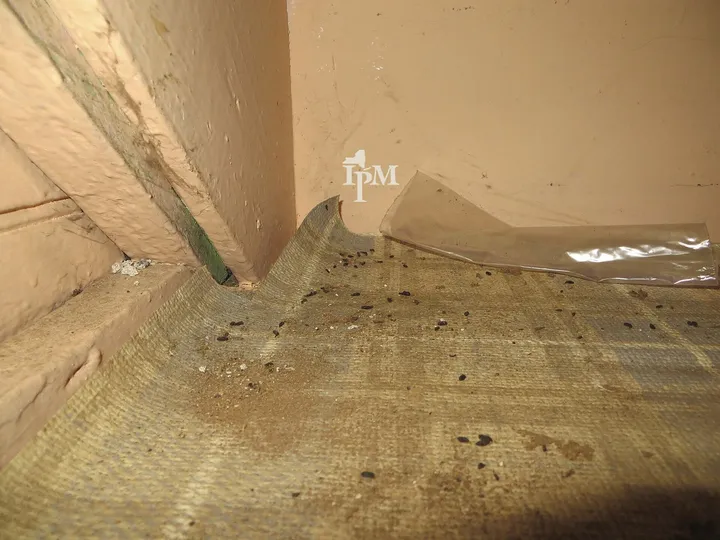

Other signs of mice and rats
- Timing of noise. DEEP says rats and mice are active mostly at night, with peaks at dusk and again at dawn. Scratching in walls or ceilings at those hours is typical.
- Gnawing. Rodents gnaw through wood, plaster, plastic and soft metals, and DEEP warns about damage to stored goods and wiring.
- Nests. Shredded paper, fabric or insulation in drawers, boxes, cabinets or behind appliances.
- Burrows. Holes along the foundation or under slabs point to rats rather than mice.
How to get rid of mice: seal, starve, trap
DEEP’s advice, which it calls “The Rat Patrol,” puts prevention ahead of poison. Removing food, water and shelter “can reduce their populations rapidly.”
1. Rodent-proof the house
- Make sure basement windows are secure and not broken.
- Seal cracks and openings in the foundation and around pipes, utility lines, drains and vents with cement, steel wool, metal flashing or 1/4-inch hardware cloth.
- Keep exterior doors tight-fitting and closed.
- Trim weeds, brush and foundation plantings back from the house.
DEEP’s wording is blunt: “Every possible route of entry must be considered.” For rats, that includes any gap of 1/2 inch.
The same sealing keeps out spiders and basement bugs such as camel crickets.
2. Take away shelter, food and water
- Get rid of piles of rubbish, building materials and old furniture. Store what you keep at least 18 inches off the ground and 12 inches from walls and fences.
- Use rodent-proof trash cans with tight lids, and keep dumpsters closed with drain plugs in place.
- Don’t leave pet food out, store bulk food in sealed containers and put bird feeders on raised platforms.
- Fix leaky faucets and empty anything that collects water.
3. Trap mice along the walls
DEEP says mice “can be trapped easily by placing snap traps along walls where mice are likely to travel,” and that peanut butter makes the trap more attractive. Rats are more cautious and harder to trap, so removing what they need is the main control. Wear rubber or plastic gloves when you empty traps, as the CDC advises for any rodent cleanup.
4. Think carefully before using baits
Rodenticide baits can be effective “if there is an established population,” DEEP says. But a poisoned rodent may die inside a wall or another spot you cannot reach, leaving odor and inviting other pests. DEEP adds that the idea that they leave the building to look for water “is not true.” Keep any bait away from children and pets, and follow the label exactly.
How should you clean up mouse droppings?
Rodent droppings and urine are the main health concern indoors. The CDC’s clean-up steps are:
- Open doors and windows and let the space air out for 30 minutes before you start.
- Wear rubber or plastic gloves.
- Do not sweep or vacuum droppings, urine or nesting material.
- Spray them with a bleach solution or an EPA-registered disinfectant until very wet, and let it soak for 5 minutes or as the disinfectant label directs.
- Wipe up with paper towels, bag them, then disinfect the area and wash your gloved hands.
CAES notes that cleaning up droppings in confined areas “can pose a risk for exposure to hantavirus.” The risk in Connecticut is low: the Department of Public Health reports one case in the state since 1995, in 2014. That is still a reason to follow the CDC steps rather than reach for a broom.
Mice and ticks are linked outdoors. White-footed mice are a main source of the Lyme bacterium for young ticks. CAES says there are no ticks on these mice in winter, and that inside buildings they do not pose a Lyme risk. If mice are thick around your stone walls and woodpile, see tick control for the yard side of the problem.
What a certified applicator does
When sealing and trapping have not worked, or rats are involved, a DEEP-registered pest control company can take over. DEEP’s certification category descriptions list rodent control as category 7D (“rats and mice”). A good visit follows the same order DEEP recommends:
- Inspection. Inside and out: the foundation, the sill, utility entries, the garage, the attic and crawl space, and where droppings are concentrated.
- Exclusion. Sealing the entry points with durable materials such as steel wool, metal flashing, hardware cloth or cement. Ask whether exclusion work is included in the price or quoted separately.
- Trapping. Snap traps or other devices placed along travel routes, with follow-up visits to check them.
- Baiting, if needed. Tamper-resistant bait stations, placed where children, pets and wildlife cannot reach them, with the product named in writing.
- A follow-up plan. When they will come back, and what you should see (fewer droppings, empty traps) if it is working.
Before agreeing to any pesticide application, the company must give you the product name, EPA registration number, active ingredients, signal word, precautions and reentry information (Connecticut General Statutes, chapter 441). Every pesticide application business needs a DEEP registration and must print its number on written contracts, vehicles and newspaper, billboard and directory ads.
Connecticut’s rodenticide rule
Connecticut’s 2025 environmental law, Public Act 25-33, section 31, directs DEEP to classify the second-generation anticoagulant rodenticides (brodifacoum, bromadiolone, difenacoum and difethialone) as restricted use pesticides by January 1, 2026. Restricted use pesticides may be used only by certified applicators.
This guide could not find a DEEP notice confirming that the classification has been completed, so it does not say the rule is in force. If a company plans to use one of these four active ingredients, ask about its current status. If you buy bait yourself, read the active ingredient on the label, and remember DEEP’s warning about rodents dying where you cannot reach them.
How much does a mouse exterminator cost?
Three national cost guides price rodent work. Their figures are shown on separate rows with their dates and never averaged, and no published source gives a Connecticut or Fairfield County price.
| What is priced | Figure | Source |
|---|---|---|
| Mice and other rodents | $180 to $600 | This Old House, national, as of March 2026 |
| One pest control visit | $50 to $500, national average $171 | This Old House, national, as of March 2026 |
| Do-it-yourself products | “usually costing less than $100” | This Old House, national, as of March 2026 |
| Rodents | $180 to $540 | Bob Vila, national, as of September 2024 |
| One-time rodent removal | $225 to $500, more “to include rechecks, dead body removals, or live trapping” | Fixr, national, as of January 2025 |
| Exclusion (sealing entry points) on its own | This guide found no published figure |
What moves a mouse quote up or down:
- How many entry points need sealing, and whether exclusion is priced into the job or quoted separately.
- Rats or mice. Rats are harder to trap, and DEEP says controlling their food, water and shelter matters most.
- The number of follow-up visits to check traps or stations.
- Building type. In multi-unit buildings, the work may need to cover more than one unit.
Is an exterminator worth it for mice?
For a few mice in a house you can seal, often not. DEEP’s rodent page says mice “can be trapped easily by placing snap traps along walls.” This Old House puts do-it-yourself products at “usually costing less than $100,” against $180 to $600 for mice and other rodents (national, as of March 2026). Paying makes more sense when trapping has not worked, the entry points are hard to find or reach, or rats are involved. DEEP says rats “tend to be very cautious” and “may be difficult to trap.” Either way, decide quickly. DEEP says rats and mice breed “every three to four weeks,” so it advises acting “at the first sign of their presence.”
Get the price, the visit schedule and the products in writing. The Connecticut pest control cost guide collects the sourced national ranges for other pests.
How to choose a company for mice
- Registration and certification. A DEEP business registration number on the contract, and a supervisor certified for category 7D if rodenticides are used.
- Exclusion first. A company that seals entry points and explains where they are is doing what DEEP recommends. One that offers only bait boxes outside is leaving the door open.
- Ask about baits inside. Given the risk of rodents dying in walls, ask why they would use bait indoors rather than traps.
- Written follow-up. Dates for return visits and what happens if mice are still active.
- No “safe” claims. EPA treats claims that a pesticide is “safe” as false or misleading (40 CFR 156.10).
This guide does not recommend or rank companies. It also does not cover squirrels, raccoons, bats or other wildlife.
Mice and rats in five Fairfield County towns
- Bridgeport has the oldest housing of Fairfield County’s 23 towns: median year built 1955, with 32.3% of homes built before 1940, according to the Census Bureau’s American Community Survey. Before a building is demolished, the city’s health department must complete a rodent-free inspection, and the certificate is valid for 30 days. Rental-property complaints go to Housing and Commercial Code Enforcement. See pest control in Bridgeport.
- Danbury’s Environmental Health division responds to complaints that “can involve issues such as rodents.” The city’s Housing Program lets a tenant request an inspection when a landlord does not respond. See pests in Danbury.
- Stamford is a city of shared walls: only 33.8% of its housing units are detached single-family homes, and 51.2% of occupied homes are rented, according to the American Community Survey. In a building with shared walls, sealing one unit may not be enough; ask the landlord or building manager about the whole building. See pest control in Stamford.
- Norwalk has older housing too: 41.8% of its homes were built before 1960. See pests in Norwalk.
- Shelton has many townhouses and condominiums: 12.2% of its housing units are attached single-family homes, the third-highest share of the county’s 23 towns. A mouse in one attached unit can travel along the shared wall, so tell the association or neighbors as well as sealing your own side. The Naugatuck Valley Health District responds to housing code health and safety violations in Shelton. See mice in Shelton condos and townhouses.
Other pests come indoors as the weather cools; see the fall invaders guide. For roaches in the same buildings, see cockroach control, and for business premises, commercial pest control.
Sources
- CT DEEP, Rat and Mouse Control: https://portal.ct.gov/DEEP/Pesticides/Integrated-Pest-Management/Rodent-Management
- CAES, Tick Management Handbook (Bulletin 1010, 2007): https://portal.ct.gov/-/media/caes/documents/publications/bulletins/b1010pdf
- CDC, How to Clean Up After Rodents (April 2024): https://www.cdc.gov/healthy-pets/rodent-control/clean-up.html
- CT Department of Public Health, hantavirus memo (May 11, 2026): https://portal.ct.gov/-/media/dph/infectious-diseases-branch/alerts/hantavirus-outbreak-memo-may-11-2026.pdf
- CT DEEP, commercial applicator certification category descriptions: https://portal.ct.gov/-/media/deep/pesticides/certification/supervisor/catinfopdf.pdf
- Connecticut General Statutes, chapter 441: https://www.cga.ct.gov/current/pub/chap_441.htm
- Connecticut Public Act 25-33: https://www.cga.ct.gov/2025/ACT/PA/PDF/2025PA-00033-R00SB-00009-PA.PDF
- This Old House, pest control cost (national, updated March 2026): https://www.thisoldhouse.com/pest-control/pest-control-cost
- eCFR, 40 CFR 156.10: https://www.ecfr.gov/current/title-40/part-156/section-156.10
- US Census Bureau, ACS 2020–2024 table B25034 (year structure built): https://data.census.gov/api/access/data/table?id=ACSDT5Y2024.B25034&g=040XX00US09$0600000
- US Census Bureau, ACS 2020–2024 table B25035 (median year built): https://data.census.gov/api/access/data/table?id=ACSDT5Y2024.B25035&g=040XX00US09$0600000
- US Census Bureau, ACS 2020–2024 table B25024 (units in structure): https://data.census.gov/api/access/data/table?id=ACSDT5Y2024.B25024&g=040XX00US09$0600000
- US Census Bureau, ACS 2020–2024 table B25003 (tenure): https://data.census.gov/api/access/data/table?id=ACSDT5Y2024.B25003&g=040XX00US09$0600000
- City of Bridgeport, rodent-free inspection: https://www.bridgeportct.gov/government/departments/environmental-health/rodent-free-inspection
- City of Bridgeport, Housing and Commercial Code Enforcement: https://www.bridgeportct.gov/government/departments/housing-code
- City of Danbury, Environmental Health: https://www.danbury-ct.gov/215/Environmental-Health
- City of Danbury, Housing Program: https://www.danbury-ct.gov/219/Housing-Program
- Bob Vila, How Much Does Pest Control Cost? (national, updated September 5, 2024): https://www.bobvila.com/articles/pest-control-cost/
- Fixr, How Much Does It Cost To Hire An Exterminator? (national, updated January 31, 2025): https://www.fixr.com/costs/pest-control
- Naugatuck Valley Health District, Environmental Health: https://www.nvhd.org/environmental-health/
Frequently asked questions
What is the 5 day mouse rule?
No Connecticut or federal agency source this guide found defines a "5 day mouse rule." What CT DEEP does say is more useful: mice breed every three to four weeks and nest within 10 to 30 feet of their food, so act at the first sign by sealing entry points and setting snap traps along walls.
What type of mice do we have in Connecticut?
The house mouse is the main indoor pest, and CT DEEP names it and the Norway rat as the most common rodent pests. Woodland white-footed mice, which CAES says are hard to tell from deer mice, also get into buildings, "especially during the winter months," from stone walls, woodpiles and brush.
How much does it cost to get pest control out for mice?
This Old House puts mouse and other rodent treatment at $180 to $600 (national data, as of March 2026), with a national average of $171 for a single pest control visit. No published source gives a Fairfield County price. The number of entry points to seal and follow-up visits drive the quote.
Will mice leave the house to look for water after eating bait?
No. CT DEEP calls the idea that poisoned rodents leave the building in search of water an "old wives tale" that "is not true." Baited mice can die inside walls and other spots you cannot reach, causing odor and secondary pests, which is why DEEP advises careful thought before using baits.
Can mice in the house give you Lyme disease?
Not indoors in winter, according to CAES. White-footed mice outdoors are a main source of the Lyme bacterium for young ticks, but CAES says there are no ticks on these mice during the winter and that inside buildings they do not pose a Lyme risk. Droppings are the bigger indoor concern.
Who do I call about rats or mice at a rental in Bridgeport or Danbury?
Tell your landlord in writing first. In Bridgeport, Housing and Commercial Code Enforcement (203-576-7072) handles rental-property violations. In Danbury, Environmental Health takes complaints involving rodents, and the Housing Program lets a tenant ask for an inspection if the landlord does not respond.