Wasp, hornet and yellowjacket nest removal in Fairfield County, CT
Wasp, hornet and yellowjacket nests in Fairfield County peak in late summer, when CAES says a yellowjacket colony can hold 1,000 to 4,000 insects. A nest that is out of the way can be left until frost ends it. One in a wall, in the ground by a path or near anyone allergic is worth having a certified applicator treat.
Found a tick or a nest right now?
- Tick bite: save the tick. Save it dry in a sealed bag; send it to CAES for free testing through your health department or by mail. See a doctor if a rash or fever follows.
- Nest by the door: keep back. Keep people and pets away from the nest; trouble breathing or hives all over need medical care right away.
- Droppings: air the room, then wet-clean. Air the room for 30 minutes, wear gloves and soak droppings with disinfectant or bleach before wiping; never sweep or vacuum them.
- Suspected bed bugs: report it. Renters tell the landlord, who has five business days to inspect; homeowners ask a DEEP-registered pest control company to inspect.
Which wasps and hornets build nests in Connecticut?
The Connecticut Agricultural Experiment Station’s yellowjacket fact sheet explains that yellowjackets are wasps in the family Vespidae. That family “includes the yellowjackets, paper wasps, hornets, potter wasps, and mason wasps.” The sheet names the four yellowjackets most often encountered in Connecticut:
- the common yellowjacket, Vespula vulgaris;
- the German yellowjacket, Vespula germanica;
- the eastern yellowjacket, Vespula maculifrons;
- the aerial yellowjacket, Dolichovespula arenaria.
Two other insects cause worry. A CAES pest alert on large wasps says the European hornet, Vespa crabro, was “introduced in 1800’s, established in CT, but rarely found.” The cicada killer is “native to U.S. and commonly found in CT in July and August.” The giant hornet was intercepted in Washington State in 2019 and is “not established or found in CT.”
Bald-faced hornets
The bald-faced hornet, Dolichovespula maculata, is not a true hornet. The University of Maryland Extension’s guide to hornets calls it a type of “aerial” yellowjacket and says the European hornet is the only true hornet established in the U.S. It is black and white with a white face, and workers are 5/8 to 3/4 inch long. The gray paper nest is cone- or egg-shaped and built in the open. It may hang from a branch “potentially up to 60 feet or more high in the canopy,” or be fixed at least 3 feet up on an overhang, wall or utility pole. At its peak a nest may hold about 100 to 400 workers. UMD notes nests are easy to miss until winter reveals them. Those empty winter nests are not reused, as the next section explains.
Cicada killers (ground wasps that rarely sting)
The large wasps digging in a sandy lawn in July are usually eastern cicada killers. CAES’s cicada killer fact sheet calls it “New England’s largest species of solitary wasp,” with females 1.5 to 2 inches long. Males defend small territories, but “it is all a bluff,” because they lack a stinger. Stings from females are “rare occurrences,” usually from direct handling, and the wasps lack the nest-defending instinct of yellowjackets and hornets. Each female digs her own burrow in loose sandy soil. CAES does not recommend pesticides for them, citing “a high risk of non-target effects on local pollinators.” Thick, well-fed turf with fall seeding discourages digging in later years.
Pest calendar
| Pest | Peak months | January | February | March | April | May | June | July | August | September | October (this month) | November | December |
|---|---|---|---|---|---|---|---|---|---|---|---|---|---|
| Yellowjackets, 1 | Aug–Sep | none reported | none reported | none reported | active | active | active | active | peak | peak | active | none reported | none reported |
- Peak: the busiest months
- Active
- None reported
- October (this month)
Sources
Bees vs wasps: carpenter bees, ground bees and honey bees
Bees are not wasps, and most of them need no treatment. Telling them apart comes first.
- Honey bees are social and “live in man-made hives or in hollow trees,” says CAES’s ground nesting bees fact sheet. The CAES yellowjacket sheet notes that yellowjackets keep their stingers when they sting while honey bees lose theirs.
- Carpenter bees are the large bees hovering at the eaves in spring. CAES’s carpenter bee fact sheet says they are 3/4 to 1 inch long, with a hairless, shiny black abdomen where a bumble bee’s is hairy, yellow and black. Females chew round holes “the size of a dime” into exposed, unpainted wood such as fascia boards, decks and railings. Males hover near people but have no stinger. CAES says oil- or polyurethane-based paint deters them, while wood stains do not.
- Ground bees dig tunnels 1/4 to 1/2 inch wide in sparse, loose, sandy soil. They are mostly native pollinators, “rarely sting,” and are usually active for three to four weeks, CAES says. It does not encourage pesticides for them. The clue that separates them from a yellowjacket ground nest: many yellowjackets use one entrance, while each ground bee uses its own.
If you are not sure which you have, get the insect identified before anyone treats it.
When are wasp nests biggest? How a nest grows
The CAES fact sheet describes a yearly cycle that explains why nests seem to appear suddenly in August:
- Spring. A single queen that survived the winter builds a small paper nest of chewed wood fiber. Nests can be “beneath the soil surface, in tree cavities, building walls, or any protected cavity or overhang.” She makes 30 to 55 cells and lays one egg in each.
- Early summer. In about 30 days the first 5 to 7 workers emerge and take over foraging and nest building, and the queen switches to laying eggs full time.
- Late summer. The colony “increase[s] throughout the summer until they peak at 1,000 to 4,000 individuals, depending on the species.”
- Fall. New queens and males are produced and leave to mate. The new queens find places to overwinter, and “all other members of the population die off, either by a heavy frost or other natural causes.”
“Nests are occupied for only one season,” CAES says. An empty nest you find in winter will not be reused, and a nest found in October may be close to dying out on its own.
Should you leave a wasp nest alone?
CAES calls yellowjackets “beneficial”: they prey on flies and caterpillars, and in one study wasps from one colony collected 225 flies an hour. That is a reason to leave a nest that is far from doors, paths and play areas, especially late in the season. “Yellowjackets rarely sting if they are left alone,” the fact sheet says.
A nest needs action when it is:
- inside the house, in a wall, attic or soffit;
- in the ground in a lawn you mow, a path, a play area or near a doorway;
- close to someone with a history of serious reactions to stings;
- at a business or school entrance, where many people pass.
How do you know there is a nest nearby?
- A steady line of wasps flying in and out of one spot in the lawn, a stone wall, a gap in siding or a hole under the eaves. CAES suggests “patiently watching for flight routes” to find it.
- Yellowjackets indoors in fall. CAES says this “may indicate a nest in a nearby wall cavity,” because workers are drawn to warmer indoor air as the weather cools.
- A paper nest on a branch, a shrub, an eave or a deck. CAES lists shrubbery, trees and the exterior of buildings among common nest sites.
- Wasps at trash and food. Yellowjackets forage for sweets, protein and water “up to a mile from the nest.” Wasps at a picnic do not always mean a nest nearby.
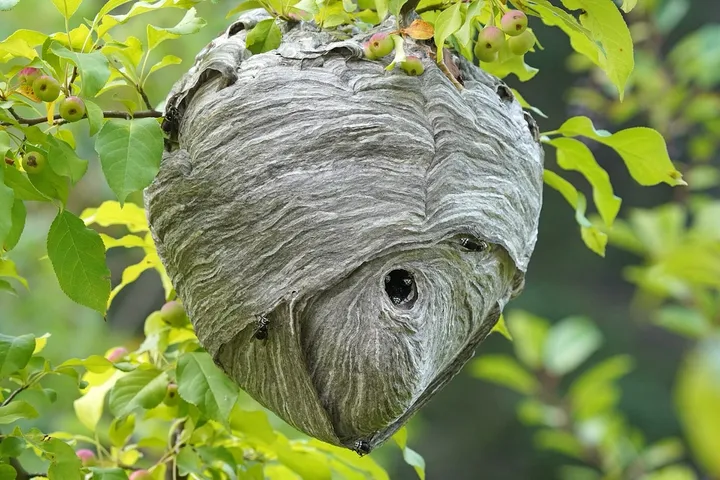

CAES lists common nest sites as “woodland edges, stone walls, shrubbery, trees, the interior and exterior of buildings, leaf litter, debris and lawns.”
Can you remove a wasp nest yourself?
Sometimes, but the CAES yellowjacket fact sheet sets out a careful method, and some nests are a poor fit for it. Connecticut requires a DEEP certificate for anyone applying pesticides on property they do not own or rent, and for any use of restricted use pesticides (CGS 22a-47 and 22a-54). For a product sold for home use on your own property, the label is the rule to follow. CAES says to “Read the manufacturers’ recommendations carefully before treating the colony.”
When doing it yourself is reasonable
People usually handle a small nest themselves when they can see it clearly, reach it from the ground and walk away from it quickly. Think of a paper nest low on a shrub, a deck rail or a shed eave. Even then, it is worth asking first whether the nest needs treating at all. CAES calls yellowjackets “beneficial” predators, and nests are “occupied for only one season.” A nest well away from doors and paths in September can often be left for frost to end.
When it is not
- Anyone in the house is allergic to stings. Connecticut Poison Control, as CAES passes on, advises people with a history of allergic reactions to keep an epinephrine auto-injector on hand. A nest near them is a job for someone else.
- The nest is inside a wall, attic, soffit or chimney. CAES says yellowjackets indoors in fall “may indicate a nest in a nearby wall cavity.” For hard-to-reach nests, “especially in buildings,” it points to a pest management professional. Spraying at the entrance does not reach the nest.
- It is in the ground in a lawn you mow, a path or a play area. A ground nest is easy to disturb by accident, with a mower or a foot. CAES warns that yellowjackets “can become extremely aggressive if disturbed.”
- It needs a ladder. Treating a nest at height puts you close to a colony that may turn aggressive, with no quick way to back off.
- You are not sure what the insects are. Honey bees are not wasps; CAES notes that yellowjackets keep their stingers while honey bees lose theirs.
The CAES method, whoever does the work
The fact sheet sets out the same steps for anyone treating a nest:
- Find the nest and treat it. “Spraying individual yellowjackets will not control additional activity.” Traps “may provide some temporary control for short outdoor events” but do not end a colony. CAES suggests “patiently watching for flight routes” to find it.
- Do not disturb it first. Mark the spot “with a bright marker so that the nest can be easily found at night.”
- Do not plug the hole. CAES is direct: “Do not plug the access hole.”
- Work at night. “Never attempt to treat the nest during the day.” Night work is recommended because yellowjackets “have very poor night vision” and are less active when it is cooler.
- Match the product to the nest. CAES describes insecticidal dusts placed in and around underground nest entrances and aerosols for aerial nests, used according to the label.
A nest inside a wall is the clearest case for professional help, because the nest itself has to be reached and treated, not just the insects at the entrance. Use only a product labeled for the job, and only as the label directs.
Avoiding stings around the yard
CAES’s prevention list is practical and needs no pesticide:
- Keep garbage cans covered with tight lids, away from picnic areas, and wash them regularly.
- Cover food outdoors, serve sweet drinks in covered cups with straws, and check food and drinks before eating.
- Fix dripping outdoor faucets and keep birdbaths away from the house.
- Don’t go barefoot, and skip perfume, scented lotion and bright clothing outdoors.
- Take care raking leaf litter at the yard’s edge, and watch ahead of the mower for ground nests.
- Stay calm when a wasp lands on you; don’t swat.
What should you do if someone is stung?
CAES passes on Connecticut Poison Control’s advice. A cold compress works better than baking soda, meat tenderizer or other home remedies, and the discomfort usually lasts about an hour. Then watch for a serious allergic reaction: swelling of the whole limb, breathing difficulty, rash or hives all over the body, or “a feeling of impending doom.” If any of these appear, seek immediate medical attention. The Connecticut Poison Control hotline is 1-800-222-1222. CAES adds that people with a history of allergic reactions to stings should keep an epinephrine auto-injector on hand and replace it every 18 months.
Connecticut rules for nest treatment
Who may treat for hire. Anyone applying pesticides for hire needs a DEEP certificate. The business needs a DEEP registration number shown on written contracts, vehicles and newspaper, billboard and directory ads (Connecticut General Statutes, chapter 441). DEEP’s certification category descriptions place “a wasps nest” in the immediate vicinity of a structure under category 7A, General Pest Control. Before agreeing to apply a pesticide, the company must give you the product’s label details, including active ingredients, signal word and reentry information.
Signs outdoors. For an outdoor application within 100 yards of a property line, CGS 22a-66a(c) requires a sign “at any conspicuous point of entry.” A commercial applicator must also post a sign every 150 feet of road frontage of the treated property.
Child care facilities. Under CGS 19a-79a, only a certified applicator may apply pesticide inside a child care facility. An emergency application “to eliminate an immediate threat to human health,” including “stinging insects,” is allowed when the operator decides it is necessary and an applicator is impractical to get. It must not involve a restricted use pesticide. Children stay out of the area until the label allows. Parents are notified at least 24 hours before an application on the grounds, or as soon as practicable in an emergency.
Schools. At schools, CGS 10-231b allows only certified applicators to apply pesticide in buildings or on grounds, with a narrow emergency exception. The commercial pest control guide covers the notice rules for schools.
Equipment that is banned. Automatic residential misting equipment is banned in Connecticut (CGS 22a-66n, in chapter 441). A company should never offer to install it.
No pesticide is described as safe in this guide; EPA treats safety claims on pesticide labeling as false or misleading (40 CFR 156.10).
How much does wasp nest removal cost?
Two of the three national cost guides this site uses list wasps; their ranges are shown on separate rows and never averaged. None gives a Connecticut price.
| What is priced | Figure | Source |
|---|---|---|
| Wasps | $300 to $700 | This Old House, national, as of March 2026 |
| Wasps | $100 to $1,300 | Bob Vila, national, as of September 2024 |
| One-time visit for common household insects, a group Fixr says includes wasps | $158 to $288 | Fixr, national, as of January 2025 |
| A price by nest type (ground, wall, aerial) | This guide found no published figure |
Several things raise the price. A nest may be inside a wall or chimney, or high enough to need a tall ladder. There may be several nests on one property, or you may want the dead nest removed afterward. The guide to pest control costs in Connecticut has the other national ranges.
How to choose a company for a nest
- Check the paperwork: a DEEP registration number on the quote and a supervisor certified in category 7A.
- Ask when they will treat. CAES advises night treatment; ask whether the company follows that.
- Ask about wall nests: how they reach the nest and whether they will open or patch anything.
- Ask what happens if the nest is still active a few days later.
- Be wary of “safe” claims.
This guide does not recommend or rank companies.
Nests in four Fairfield County towns
Yards, stone walls and lawns are where CAES says many nests are built, and the county’s suburban towns are mostly detached houses with yards. Figures are from the Census Bureau’s American Community Survey, 2020–2024, table B25024.
- Westport has the highest share of detached single-family homes of the 10 towns this guide covers, 87.7%. See pest control in Westport.
- Darien: 85.1% of homes are detached. See pests in Darien.
- Fairfield: 77.5% are detached. See pest control in Fairfield.
- Greenwich: 63.7% are detached. See pests in Greenwich.
For the other outdoor pest of a Fairfield County summer, see the tick season guide for Fairfield County. Large ants around a deck or porch are a different problem: see carpenter ant control. Insects coming indoors in fall are covered in the fall invaders and stink bugs guide.
Sources
- CAES, Yellowjackets (Family Vespidae) fact sheet: https://portal.ct.gov/-/media/caes/documents/publications/fact_sheets/entomology/yellowjackets_vespidae.pdf
- CAES, pest alert on cicada killer, European hornet and giant hornet: https://portal.ct.gov/-/media/caes/documents/publications/pest_alerts/caes_gianthornet02.pdf
- Connecticut General Statutes, chapter 441: https://www.cga.ct.gov/current/pub/chap_441.htm
- CT DEEP, commercial applicator certification category descriptions: https://portal.ct.gov/-/media/deep/pesticides/certification/supervisor/catinfopdf.pdf
- Connecticut General Statutes, chapter 368a (section 19a-79a): https://www.cga.ct.gov/current/pub/chap_368a.htm
- Connecticut General Statutes, chapter 170 (section 10-231b): https://www.cga.ct.gov/current/pub/chap_170.htm
- eCFR, 40 CFR 156.10: https://www.ecfr.gov/current/title-40/part-156/section-156.10
- This Old House, pest control cost (national, updated March 2026): https://www.thisoldhouse.com/pest-control/pest-control-cost
- US Census Bureau, ACS 2020–2024 table B25024 (units in structure): https://data.census.gov/api/access/data/table?id=ACSDT5Y2024.B25024&g=040XX00US09$0600000
- Bob Vila, How Much Does Pest Control Cost? (national, updated September 5, 2024): https://www.bobvila.com/articles/pest-control-cost/
- Fixr, How Much Does It Cost To Hire An Exterminator? (national, updated January 31, 2025): https://www.fixr.com/costs/pest-control
- University of Maryland Extension, Hornets (baldfaced hornet): https://extension.umd.edu/resource/baldfaced-hornet
- CAES, Cicada Killer Wasp fact sheet: https://portal.ct.gov/-/media/caes/documents/publications/fact_sheets/entomology/cicada_killer_wasp_sphecius.pdf
- CAES, Carpenter Bees fact sheet: https://portal.ct.gov/-/media/caes/documents/publications/fact_sheets/entomology/carpenter_bees_xylocopa.pdf
- CAES, Ground Nesting Bees fact sheet: https://portal.ct.gov/-/media/caes/documents/publications/fact_sheets/entomology/groundnestingbeespdf.pdf
Frequently asked questions
How much does wasp nest removal cost?
This Old House puts wasp treatment at $300 to $700 (national, as of March 2026), and Bob Vila at $100 to $1,300 (national, as of September 2024). This guide found no Connecticut figure and no published price by nest type. Ask how the nest's location, such as a wall cavity or a high eave, affects the quote.
Should I remove a wasp nest myself?
Only a small, exposed nest you can reach without a ladder, and only if no one in the house is allergic. CAES says never to treat a nest during the day, not to plug the entrance and to call a professional for hard-to-reach nests, especially in buildings. Yellowjackets can become "extremely aggressive if disturbed."
Why are yellowjackets inside my house in the fall?
Probably a nest in a wall. CAES says yellowjackets flying inside the home during the fall "may indicate a nest in a nearby wall cavity," because workers are drawn to warmer indoor air as the weather cools. CAES also advises not to plug the access hole, and suggests a pest management professional for hard-to-reach nests in buildings.
Do wasps reuse the same nest next year?
No. CAES says yellowjacket nests are occupied for only one season. New queens leave in late summer, mate and overwinter, and the rest of the colony dies off, usually with a heavy frost. In spring each surviving queen starts a new nest, so an empty nest found in winter does not need treatment.
Are there giant hornets in Connecticut?
No. CAES says the giant hornet was intercepted in Washington State in 2019 and is not established or found in Connecticut. The European hornet was introduced in the 1800s and is established here but rarely found. The cicada killer, a large native wasp, is common in Connecticut in July and August.
Can a daycare in Connecticut spray a wasp nest?
Usually only a certified applicator may apply pesticide inside a child care facility, but CGS 19a-79a allows an emergency application to eliminate an immediate threat to human health, naming "stinging insects." It must not use a restricted use pesticide, and children stay out until the label allows. For an emergency application on the grounds, parents get notice as soon as practicable.