Carpenter ant control in Fairfield County, CT
Carpenter ants in a Fairfield County house usually mean water-damaged wood: CAES says they “cannot excavate undamaged wood.” Control means finding the nest, fixing the leak or rot that drew them, then baiting or treating the colony. They are most active on spring evenings, which is also the best time to look for the nest.
What carpenter ants are
The Connecticut Agricultural Experiment Station’s carpenter ant fact sheet names three species most likely to set up colonies in Connecticut buildings:
- the eastern black carpenter ant, Camponotus pennsylvanicus, “one of the largest ants in New England” and “the most common building infesting ant.” Workers are 1/4 to 1/2 inch long and winged reproductives 1/2 to 3/4 inch;
- a smaller black carpenter ant, Camponotus nearcticus, less common, which “usually nests near window and door frames”;
- the red carpenter ant, Camponotus chromaiodes, in between in size, with a reddish-brown thorax.
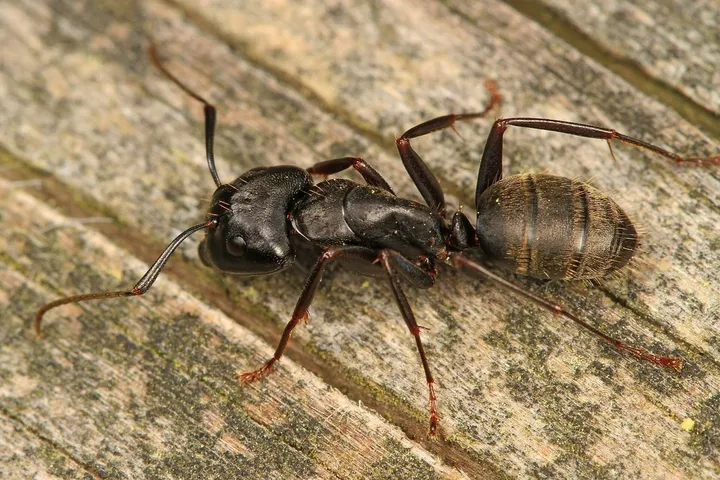

The key fact for a homeowner is in the sheet’s first lines: “Carpenter ants create nests by hollowing out water-damaged wood,” and “unlike termites, carpenter ants cannot excavate undamaged wood.” So when they are found nesting in a house, “it is evidence that there may be water-damaged wood in the structure.” Outdoors they nest in decaying trees, stumps and fence posts. Queens usually choose moist spots but “may use cavities that are structurally sound and dry.”
Carpenter ants do not eat wood. They dig galleries in it and push the sawdust out. They feed mostly on honeydew from aphids and scale insects, on other insects and on plant material. Indoors they will eat jam, honey, sugar, overripe fruit, bread crumbs, grease and fat.
Pest calendar
| Pest | Peak months | January | February | March | April | May | June | July | August | September | October (this month) | November | December |
|---|---|---|---|---|---|---|---|---|---|---|---|---|---|
| Carpenter ants, 1 | Apr–Jun | none reported | none reported | none reported | peak | peak | peak | active | active | active | active | none reported | none reported |
- Peak: the busiest months
- Active
- None reported
- October (this month)
Sources
Carpenter ants or termites?
Both can be found in the same old sill or porch, and the swarmers look alike. CAES gives three ways to tell winged ants from winged termites:
| Feature | Carpenter ant | Termite |
|---|---|---|
| Antennae | Smooth and “elbowed” | Straight and “beaded” |
| Body | Narrow waist between thorax and abdomen | Broad, no constriction |
| Wings | Front wings longer than hind wings | Paddle-shaped, both pairs equal |
Timing helps too. “Termites swarm only in the spring, while ants swarm from late spring through the summer into fall,” the fact sheet says. The CAES termite fact sheet adds the damage difference: “There is no sawdust or powder associated with termite feeding.” Carpenter ants, by contrast, leave “ant dumps,” piles of sawdust mixed with debris. Termites, unlike carpenter ants, “can destroy undamaged wood.” Insects massing on the house in autumn may be a different problem. UConn’s stink bug fact sheet says that in late September and October, adult stink bugs gather “in large numbers on buildings.” The guide to stink bugs and other fall invaders covers them.
The carpenter ants vs termites guide goes further into the comparison, and the termite control page covers termite treatment.
How a colony grows
A new queen picks or digs a small cavity, “usually in moist or decayed wood,” and lays 15 to 20 eggs. Once the first workers mature, she only lays eggs; workers forage, dig, clean and defend the nest. As the colony grows, workers extend galleries into nearby wood, “and other materials such as insulation,” especially wood softened by water or rot.
A colony is mature at about 2,000 ants and takes three to six years to get there, CAES says. Only then does it produce winged swarmers. Under stress, a colony can also set up satellite nests without a queen, and workers there do the same jobs as in the main nest.
That slow growth is useful to know. A few ants indoors are a reason to look for moisture and a nest, not a reason to panic.
How do I know if I have carpenter ants?
- Large black or red-and-black ants indoors, especially in kitchens, pantries and around sinks, dishwashers and refrigerators, where CAES says indoor foraging is often seen.
- Ants at night. Carpenter ants are “generally nocturnal”; daytime ants are scouts looking for food.
- Sawdust “dump” piles, coarse sawdust mixed with dead ants and insect parts, below a hidden nest.
- Scratching in the walls. “Nocturnal scratching noises in walls or voids may indicate a nest.”
- Winged ants inside, from late spring to midsummer.
- Ant trails over foundation walls, along railings, clothes lines, utility wires and tree branches that touch the house.
Where do carpenter ants nest in a house?
CAES lists the usual indoor sites: un-split firewood, hollow-core doors, walls, ceilings, attics and behind window frames and sills. Nests are tied to moisture, at “attachment points of porches, chimneys, garages, and decks,” and in bathrooms, “behind tile covered walls surrounding bathtubs, and flooring surrounding tubs and toilets.”
Houses near outdoor nests are more likely to be infested, CAES says, and workers can forage “from 65 feet up to 100 yards from the nest.” That means a nest can be in the house with the ants feeding outside, or in a stump in the yard with ants foraging inside. Finding which one you have changes the plan.
What a certified applicator does
How do you locate a carpenter ant nest?
CAES advises inspecting “when carpenter ants are most active,” which is “generally late evening during spring and early summer.” A good inspection follows ant trails back toward the nest, looks for sawdust piles in damp areas, listens for nests in walls, and checks the moisture sources above. CAES notes that professionals “may flush out ants from suspected nest sites with small amounts of aerosol insecticide.”
Fix the moisture first
CAES calls structural control one of the two methods, and it is the part that keeps ants from coming back:
- replace or repair water-damaged wood, leaking gutters, chimney flashing, porches and damaged roof shingles;
- grade the soil so wood does not touch the ground around garages, decks and porches;
- ventilate crawl spaces, attics, basements (especially those with dirt floors and fieldstone foundations) and the space under porches and decks;
- check firewood and hollow-core doors, and remove any that hold a colony.
A pest company can point out the wet wood. Repairing it is usually work for a carpenter or roofer.
Bait or treat the colony
The chemical side has two approaches, according to CAES:
- Baits mix an attractive food with an insecticide such as boric acid. Workers carry it back to feed the colony and the queen. Activity “should lessen and stop after in approximately one week,” and baiting “is most effective during the spring.”
- Nest treatment. “Spraying a pesticide directly into a nest is the most effective way of managing a colony.” Nests can be hard to reach, which is when CAES says to bring in a professional. Products may also go around the foundation to repel foraging ants.
Should I squish carpenter ants?
Squashing a few does no harm, but it does little. The ants you see are workers out foraging, and CAES says they range “from 65 feet up to 100 yards from the nest.” The queen stays behind and switches “to just egg laying,” so the colony carries on. Penn State Extension’s carpenter ant fact sheet says “The parent and satellite colonies must be destroyed, or the ants will reappear in a few days or weeks.” A live trail is worth more than a dead ant. CAES advises watching ant trails and, “if feasible,” following them back to the nest, best on late evenings in spring and early summer.
What kills carpenter ants the fastest?
Treating the nest itself. CAES says “Spraying a pesticide directly into a nest is the most effective way of managing a colony.” Baits work more slowly, because workers carry the bait home to the colony and queen. CAES says activity “should lessen and stop after in approximately one week.” Spraying only the ants you can see is weaker. Penn State says products put where foragers travel “will provide partial control and may eliminate the colony,” and that the ants frequently “will ignore the baits.” So the fastest lasting result starts with finding the nest. For a nest that is hard to reach, CAES says to use a professional.
Ask the applicator which approach they plan and why. A company that sprays a perimeter without looking for the nest or the moisture is skipping the steps CAES puts first. No pesticide is described as safe in this guide. Ask for the label and reentry time instead, since EPA treats safety claims on pesticide labeling as false or misleading (40 CFR 156.10).
Other ants in Connecticut homes: odorous house (“sugar”) ants and pavement ants
Most small ants trailing across a kitchen counter are not carpenter ants, and they call for a different plan. Carpenter ant workers are 1/4 to 1/2 inch long. Two common small house ants are a fraction of that size.
- Odorous house ants are 1/16 to 1/8 inch long and brown to black. Penn State Extension says they give off a “rotten odor when crushed” and mostly prefer sweets. A University of Nevada Extension guide notes they are also called sugar ants. They nest outdoors under rocks and boards, and indoors in voids near moisture and warmth. Colonies have many queens.
- Pavement ants are about 2.5 to 4 mm long, dark brown to black, with fine lines on the head and thorax. Penn State’s pavement ant page puts their range from New England to the Midwest. Colonies live under sidewalks, slabs and large rocks. The ants come in through cracks in foundation walls and slabs, often leaving small piles of sand or soil.
For both, Penn State says baits are the control. Workers carry the bait back and share it with the queen and young, so slower-acting baits work best. Control “may require two weeks or longer.” DEEP’s general ant work falls in category 7A, as the rules section below explains.
Keeping carpenter ants out
Most prevention comes straight from the CAES fact sheet and costs little:
- Trim branches that touch the house. CAES lists tree branches, railings, clothes lines and telephone or electrical lines among the routes foraging ants use to reach a building.
- Store firewood away from the house and check it before bringing it in; un-split firewood is one of the nest sites CAES names.
- Keep wood off the soil around decks, porches and garages, and keep gutters, flashing and roof shingles in repair.
- Ventilate damp spaces, such as crawl spaces, attics and basements, so wood stays dry. A drier basement also draws fewer house centipedes, silverfish and camel crickets.
- Store sweet foods sealed, since indoor foragers go for sugar, jam, honey and overripe fruit.
Connecticut rules that apply
Certification. Anyone applying pesticides for hire needs a DEEP certificate. The business needs a DEEP registration number shown on written contracts, vehicles and newspaper, billboard and directory ads (Connecticut General Statutes, chapter 441). DEEP’s certification category descriptions put “termites, powder post beetles, dry rot and other wood destroying organisms” in category 7B, Termites and WDO Pest Control, which may also treat carpenter ants affecting a structure when they are traced back to a tree or fence post away from it. General household ants fall under 7A. Ask which category the supervisor holds.
Label information. Before agreeing to apply a pesticide, the company must give you the product name, EPA registration number, active ingredients, signal word, precautionary statements and reentry information.
Home sales. The NPMA-33 wood destroying insect report used for FHA and VA loans lists carpenter ants among the wood destroying insects it covers. The inspection is visual and limited to accessible areas. Connecticut’s seller disclosure report asks about “Termite, Insect, Rodent or Pest Infestation problems” and “Rot or Water damage problems” (CGS 20-327b), answered from the seller’s actual knowledge. See the termite inspection guide for how those reports work.
How much does carpenter ant control cost?
This Old House puts ant treatment at $100 to $500 (national data, as of March 2026). That range covers ants in general; this guide found no published figure for carpenter ants alone. Wood repair is extra and depends on what the moisture has damaged. The guide to pest control costs in Connecticut has the other national ranges.
How to choose a carpenter ant company
- Check the paperwork: a DEEP registration number on the quote and the right certification category.
- Ask where the nest is. A good inspector tries to find it, or explains why it could not be found.
- Ask about moisture. The report should name the wet or damaged wood, not just the ants.
- Ask about baits versus sprays and when each will be used.
- Ask what follow-up is included if ants keep appearing after a week or two.
- Be wary of “safe” claims.
This guide does not recommend or rank companies.
Carpenter ants in five Fairfield County towns
Older houses have had more years of roofs, gutters, porches and plumbing, and CAES ties indoor nests to leaks and rot at exactly those points. Age alone does not mean ants, but it is a reason to check. Figures are from the Census Bureau’s American Community Survey, 2020–2024, table B25034 (year built) and table B25035 (median year built).
- Bridgeport has the oldest housing of Fairfield County’s 23 towns: a median year built of 1955, with 32.3% of homes built before 1940. See pest control in Bridgeport.
- Darien: median year built 1956, and 56.4% of homes predate 1960. See pests in Darien.
- Fairfield: 51.1% of homes were built before 1960. See pest control in Fairfield.
- Greenwich: 25.6% of homes were built before 1940. See pests in Greenwich.
- Trumbull: 44.3% of homes date from 1950 to 1969, the most of the county’s 23 towns, so many porches, decks and roof edges are well past 50 years old. See carpenter ants in Trumbull’s postwar houses.
For the season’s other outdoor pest, see the tick season guide for Fairfield County. For stinging insects around a deck or eaves, see wasp and hornet nest removal.
Sources
- CAES, Carpenter Ants (Camponotus sp.) fact sheet: https://portal.ct.gov/-/media/caes/documents/publications/fact_sheets/entomology/carpenter_ants_camponotus.pdf
- CAES, Eastern subterranean termite fact sheet: https://portal.ct.gov/-/media/CAES/DOCUMENTS/Publications/Fact_Sheets/Entomology/Eastern_Subterranean_Termite_Reticulitermes.pdf
- Penn State Extension, Carpenter Ants (Steve Jacobs): https://extension.psu.edu/carpenter-ants
- UConn Home and Garden Education Center, Brown Marmorated Stink Bug: https://homegarden.cahnr.uconn.edu/factsheets/brown-marmorated-stink-bug/
- eCFR, 40 CFR 156.10: https://www.ecfr.gov/current/title-40/part-156/section-156.10
- Connecticut General Statutes, chapter 441: https://www.cga.ct.gov/current/pub/chap_441.htm
- CT DEEP, commercial applicator certification category descriptions: https://portal.ct.gov/-/media/deep/pesticides/certification/supervisor/catinfopdf.pdf
- National Pest Management Association, NPMA-33 Wood Destroying Insect Inspection Report (hosted by HUD): https://www.hud.gov/sites/dfiles/OCHCO/documents/NPMA33.pdf
- Connecticut General Statutes, chapter 392 (section 20-327b): https://www.cga.ct.gov/current/pub/chap_392.htm
- This Old House, pest control cost (national, updated March 2026): https://www.thisoldhouse.com/pest-control/pest-control-cost
- US Census Bureau, ACS 2020–2024 table B25034 (year structure built): https://data.census.gov/api/access/data/table?id=ACSDT5Y2024.B25034&g=040XX00US09$0600000
- US Census Bureau, ACS 2020–2024 table B25035 (median year structure built): https://data.census.gov/api/access/data/table?id=ACSDT5Y2024.B25035&g=040XX00US09$0600000
- Penn State Extension, Odorous House Ant: https://extension.psu.edu/odorous-house-ant
- Penn State Extension, Pavement Ant: https://extension.psu.edu/pavement-ant
- University of Nevada, Reno Extension, A Northern Nevada Homeowner’s Guide to Identifying and Managing House Ants: https://extension.unr.edu/publication.aspx?PubID=6824
Frequently asked questions
Do carpenter ants mean I have water damage?
Often, yes. CAES says carpenter ants hollow out water-damaged wood and "cannot excavate undamaged wood," so ants nesting in a house are "evidence that there may be water-damaged wood in the structure." Check around porches, decks, chimneys, window sills, bathtubs and toilets, and fix the leak as well as treating the ants.
How can I tell carpenter ants from termites?
Look at the winged swarmers. CAES says ants have elbowed antennae, a narrow waist and front wings longer than the back wings; termites have straight, beaded antennae, a broad body and four equal wings. Carpenter ants push out piles of coarse sawdust; termite feeding leaves no sawdust, only mud tubes and hollow-sounding wood.
Do carpenter ants eat wood?
No. They dig galleries in wood to nest but do not eat it. CAES says they feed mainly on honeydew from aphids and scale insects, plus other insects and plant material. Indoors they go for sugary foods such as jam, honey and overripe fruit, and also bread crumbs, grease and fat.
When are carpenter ants most active in Connecticut?
In warm months. CAES says they hibernate when winter sets in, swarm and mate from late spring to midsummer, and are most active in the late evening during spring and early summer, which CAES says is the best time to look for a nest.
How much does carpenter ant control cost?
This Old House puts ant treatment at $100 to $500 (national data, as of March 2026); its figure covers ants generally, and this guide found no carpenter-ant-specific number. Repairing the water-damaged wood the ants nested in is a separate cost, usually handled by a carpenter or roofer, not a pest company.
Will a termite inspection find carpenter ants?
It looks for them. The NPMA-33 wood destroying insect report used for FHA and VA loans counts carpenter ants as wood destroying insects, along with termites, carpenter bees and wood boring beetles. Like any visual inspection, it only covers accessible areas and cannot see inside walls.